The Legalization of Sports Betting in America
The Box Score
One of the biggest changes in American sports has been the recent legalization of sports betting.
The story of sports gambling is largely about federalism and who gets to set policy: the federal government or the states.
For most of American history, the decision to legalize sports betting was left to the states, with only Nevada taking bets.
In 1992, Congress prevented states other than Nevada from legalizing sports betting with the Professional and Amateur Sports Protection Act (PASPA).
The Supreme Court’s ruling in Murphy v. NCAA (2018) held that PASPA violated the Constitution by telling states what they could or could not do.
After Murphy, the regulation of gambling reverted to the states, with 38 states now legalizing sports gaming in some form.
While sports gambling is regulated by the states, sports prediction markets are regulated by the federal government and are currently legal for all Americans over 18.
The Complete Game
The year is 1996. If you wanted to lay a C-note on the Steelers to cover the spread, you either booked a flight to Las Vegas to do it legally or placed a bet with Lefty, the shady bookie hanging out in the back of O’Malley’s Bar. That year, Nevada sportsbooks took $2.5 billion in bets, which was dwarfed by an estimated $88 billion in illegal bets. Sports shows made only subtle references to betting, and there were no TV ads encouraging you to gamble. There were also no major professional sports teams in Nevada because legal gambling was seen as a threat to “the integrity of the game.” Placing a bet was tough enough, but finding out if you won took the patience of Job since it took 25 minutes to open AOL and load the scores in Netscape.
The year is 2026. Sports betting is legal in 38 states, and prediction markets are legal everywhere. The legal handle is well over $150 billion, with another $84 billion still flowing through bookies like Lefty. ESPN has its own betting service, and Scott Van Pelt’s best segment is always “Bad Beats.” You can’t watch a game without Kevin Hart or Jamie Foxx hawking some teaser deal from DraftKings or BetMGM. Las Vegas will soon have professional franchises in all major sports, whose commissioners now openly partner with betting services. About half of American men aged 18-49 use an app to bet on everything from the outcome of the Tarleton State vs. UT Arlington basketball game to the color of Gatorade dumped on the winning coach.
Oh, my, how things have changed!
There are many factors behind the explosion of legalized sports betting in America, including technological advances, changing public opinion, and, of course, money. But the real story is political.
Before we get to that story, there are two questions that animate this discussion.
1. Should sports gambling be legal?
2. Who decides?
Should Sports Gambling Be Legal?
As always, most political arguments are essentially about competing values, and value-based arguments are difficult, if not impossible, to resolve because there is no objective test that can say who is right.
Such is the case with sports gambling. I expect that most people’s opinions on the matter will boil down to their view of the extent of the government’s warrant. Should people be able to do what they want, even if it harms them (negative liberty)? Or should the government protect people from harm (positive liberty)?
Below, I present the cases for and against legalized sports betting in America as fairly as I can and leave it up to you to decide what is best.
Arguments Against Legalized Sports Betting
Gambling is a Sin. In the early 20th Century, evangelical preachers like Billy Sunday warned Americans that gambling was a sin alongside tobacco, alcohol, prostitution, drugs, and pornography. Historically, the government’s response to such vices has been to prohibit them or tax them to death.
Today, few Americans (29 percent) consider gambling to be a moral vice, even among the most religious (33 percent).
Gambling Undermines the “Integrity of the Game.” The mission of sports leagues and their commissioners is to safeguard the “integrity of the game.” Threats to integrity come in many forms—such as steroids, Astro players banging on trash cans, tanking in the NBA, double-touching in curling—but gambling is the greatest of them all. Nothing breaches the fundamental principle of fair play in sports more than when players shave points or take a dive.
Currently, the most controversial form of sports betting is proposition bets, or prop bets. Prop bets let you wager on nearly anything imaginable, from how many yards a quarterback will throw, how many rebounds a power forward will grab in the first half, to whether the coin lands on heads at the Super Bowl.
What makes prop bets so concerning is that they’re much easier to manipulate than traditional sports bets. In conventional sports betting, gamblers wager on an entire game. For a fix to work, a gambler would either have to bribe a player with enough juice to affect the game’s outcome or find enough players willing to do the same. Neither is a sure bet. A pitcher on the take could be pulled after a few innings, and including more players in a point-shaving scheme increases the odds that someone will talk.
Compared to traditional sports bets, prop bets are much easier to fix and harder to detect. As a gambler, all you need is to find a college power forward with some money problems and convince him to be lazy on the boards in the first half.
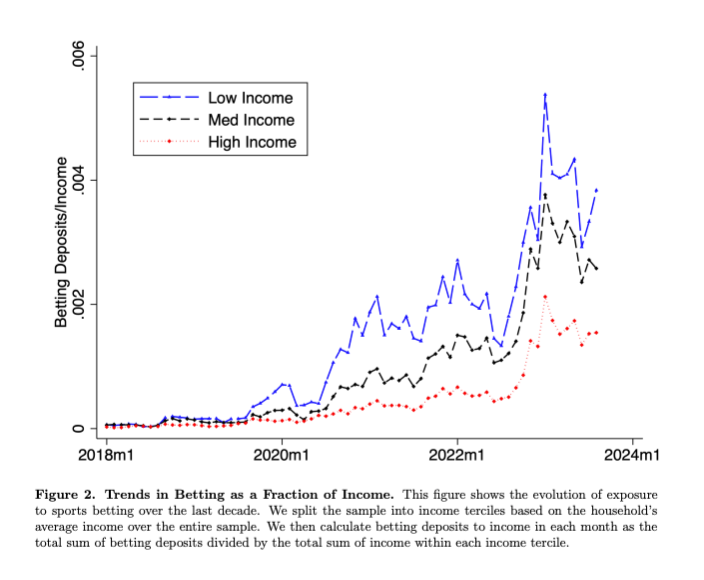
Gambling Negatively Impacts Consumer Finance. Betting on sports might be fun if you win, but it can be ruinous if you don’t. In their 2024 article, “The Financial Consequences of Legalized Sports Gaming,” Hollenbeck, Larsen, and Proserpio found that states that legalized online sports betting experienced significant decreases in consumer credit scores and increases in bankruptcy rates and loan delinquencies. In “Gambling Away Stability,” Baker et al. (2024) find that those who are least able to absorb gambling losses are the most likely to bet on the game (see figure below). They write:
“Following legalization, sports betting spreads quickly, with both the number of participants and frequency of bets increasing over time. This increase does not displace other gambling or consumption but significantly reduces savings, as risky bets crowd out positive expected value investments. These effects concentrate among financially constrained households, as credit card debt increases, available credit decreases, and overdraft frequency rises. Our findings highlight the potential adverse effects of online sports betting on vulnerable households.”
Source: R. Baker, Scott and Balthrop, Justin and Johnson, Mark J. and Kotter, Jason D. and Pisciotta, Kevin, Gambling Away Stability: Sports Betting's Impact on Vulnerable Households (June 30, 2024). Available at SSRN: https://ssrn.com/abstract=4881086 or http://dx.doi.org/10.2139/ssrn.4881086
Gambling is Addictive. Sports gambling has ruined the lives of many Americans. There are those cautionary tales of high-profile athletes like Art Schlichter and Pete Rose. But millions of average Americans have paid a high price for their gambling addiction.
Placing bets on a smartphone has only made things more dangerous. “Michael,” who runs the weekly Gamblers Anonymous meeting in Canton, Massachusetts, put it like this: “Take one of the most addictive behaviors in mankind and then combine it with one of the most addictive devices of all time. It’s obviously going to be a disaster.”
In their 2025 JAMA article, “Growing Health Concern Regarding Gambling Addiction in the Age of Sportsbooks,” authors Atharva Yeola, Matthew Allen, and Nimit Desai found that online searches for gambling addiction increased 23 percent since 2018 (see figure below).

Source: Yeloa, Atharva, Matthew R. Allen, and Nimit Desai (2025), “Growing Heath Concern Regarding Gambling Addiction in the Age of Sportsbooks,” JAMA Intern Med, Published Online: February 17, 2025, 185(4): 382-398. https://jamanetwork.com/journals/jamainternalmedicine/fullarticle/2830019
Abuse of Players. One of the more troubling trends in sports today is the abuse heaped upon players by disgruntled gamblers.
The Athletic found that 78 percent of MLB players believed sports betting has changed how fans treated players. Another survey found that a third of high-profile college athletes have received abusive messages from “betting interests.”
Sports agent Leigh Steinberg wrote an op-ed in the New York Times laying out what he sees as an unprecedented danger of gambling to players and sport:
“Yet in a rush to embrace the potential profits provided by new forms of legalized sports gambling, the professional sports leagues have put players, and the people close to them, under untenable pressure. I have represented professional athletes for 50 years and I have never seen a situation that’s more perilous to them and the integrity of sports.”
Positive Liberty. Political theorists draw a distinction between “negative” and “positive” liberty.
Negative liberty scholars—such as John Stuart Mill, John Locke, and Robert Nozick—argue that freedom means that people can do what they want, as long as they don’t hurt others.
Positive liberty scholars—such as Rousseau, Charles Taylor, and Amartya Sen—contend that true freedom means human flourishing and that sometimes people need to be coerced to be free.
A positive liberty approach to sports gambling holds that people who are addicted to the practice or can ill-afford losses are not living their best lives. Instead, they are trapped in a dark world of compulsion and loss chasing. Anyone who has suffered through addiction or watched someone else suffer knows that its depths look like anything but freedom.
Moreover, athletes who fall under the control of gamblers or the mob are not free. There are countless examples of athletes being pressured to throw a game. In one of the more famous incidents, the mob forced boxer Jake LaMotta to take a dive against Billy Fox in 1947 (I urge you to watch Raging Bull if you have not already).
Arguments In Favor of Legalized Sports Betting.
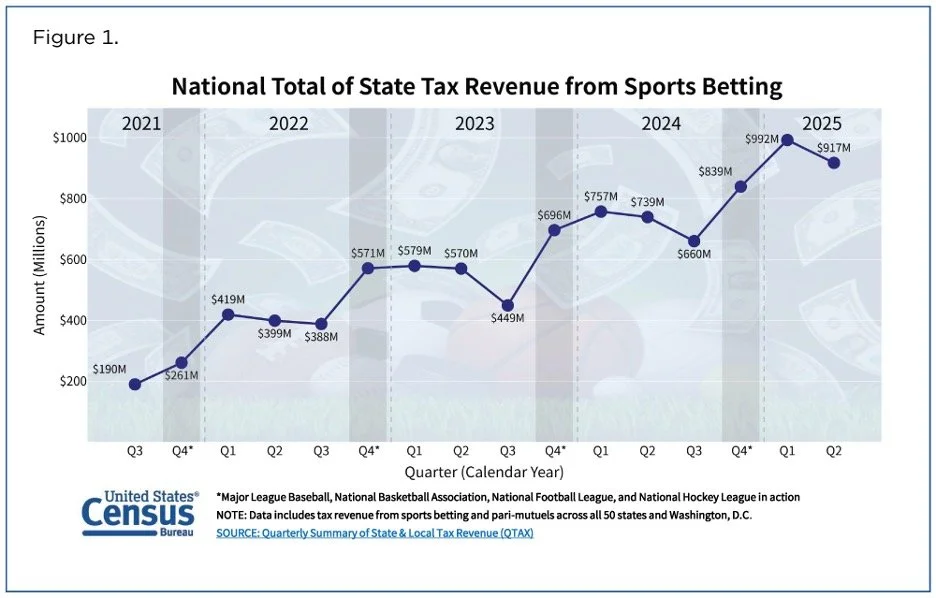
Revenue for the states. One of the central arguments in favor of legalized sports betting is that it provides states with much-needed revenue. According to the U.S. Census Bureau, sales tax revenue from sports betting rose from $190 million in 2021 to $917 million in 2025, a 382% increase. The Tax Foundation estimates that figure would climb to $1.6 billion per year if all 50 states legalized sports betting, with the largest gains coming from states where it is still illegal: California (a potential tax revenue of $570 million), Texas ($326 million), and Florida ($199 million).
Prohibition Doesn’t Work. A corollary of the revenue argument is that legislating away “sin” doesn’t work. Banning an activity doesn’t stop people from doing it; it just creates black markets controlled by organized crime. Advocates for legalization argue that Prohibition didn’t work for alcohol, and doesn’t work for sports gambling. As Professor Stephen Shapiro, an expert on sports gambling from the University of South Carolina, stated,
“Gambling was happening regardless and was seedy and illegal. Now it’s legal and there is at least some revenue being generated for the states.”
Even the NCAA, which has long been dogmatic about its abstinence-only, zero-tolerance gambling policy, seems to have had a change of heart. It has recently allowed licensed sportsbooks to use their logos and data. More surprising was its 2025 proposal to allow its coaches and players to bet on professional sports, a policy that was ultimately voted down by member institutions. A quote from Dr. Denna Casiero, the NCAA’s chief medical officer, illustrates this change in thinking inside the organization:
“Abstinence-only approaches to social challenges for college-aged individuals are often not as successful as approaches that focus on education about risks and open dialogue. The NCAA will continue to collaborate with schools to help them provide student-athletes with meaningful education and other resources for student-athletes who choose to participate in betting on professional sports. This harm reduction approach gives schools an opportunity to help student-athletes make educated decisions, prevent risky behavior and seek support without fear of impacting their eligibility.”
Increased Regulation. Advocates say one benefit of legalizing sports gaming is increased oversight. Sports leagues, sportsbooks, and state regulators all have an incentive to maintain a clean game and now partner with integrity firms like Sportradar. With legalization, there has been increased sharing of information about unusual prop bets or suspicious line movements, which has helped catch a number of cheats, including former Raptors center Jontay Porter.
Legalization has also made things a whole lot safer. In the old days, stiffing a bookie could mean that you wouldn’t be using your thumbs for a while. Say what you want about huge corporations, like DraftKings, but at least they don’t send Rocko and Lefty to your door with a Louisville Slugger to collect a debt.
It’s Fun (at least when you win). Having a little juice on the game seems like a lot of fun. Prop bets and Daily Fantasy Sports (DFS) can turn a snoozer into a nail-biter, and garbage time into money time. They have also changed the way Americans watch games. Yale Professor of Marketing, Nathan Novemsky, writes,
“These activities fundamentally change the way that fans view sports. Their excitement is not driven by teams winning and losing, so much as it is by ‘their players’ having good games (good as defined by the relevant fantasy league rules). This means that fans might be interested in many more games than they once were; they might also watch multiple games at once to track their players.”
Negative Liberty. Proponents of “negative liberty” say that people should be allowed to make their own choices, even if those choices are bad for them.
While some people might think gambling is a sin, most do not. And while some people are problem gamblers, most are not. Proponents of negative liberty say that it is not the government’s job to enforce morality or even protect us from ourselves.
Al Williams, a Georgia state representative and president-elect of the National Council of Legislators from Gaming States (NCLGS), put it best when he said, “Every man should have the right to go to hell if he wants to.”
Who decides if sports gambling is legal? The federal government or the states?
The question of sports gambling is mainly one of federalism, the division of powers between the federal government and the states. Federalism has always been one of the thorniest questions in American politics, largely because the stakes are high and the dividing line between federal and state power isn’t always clear.
Advocates of centralization favor the U.S. federal government making policy. Its proponents generally point to the Supremacy Clause of the Constitution (Article IV, Clause 2), which says that when federal and state laws conflict, federal law takes precedence—the constitutional equivalent of a tie going to the runner.
Proponents of devolution believe states should have a greater say in policy-making. Its advocates cite the Tenth Amendment of the Constitution, which says, “The powers not delegated to the United States by the Constitution, nor prohibited by it to the States, are reserved to the States respectively, or to the people.”
That, in a nutshell, is the political debate over sports gambling: Should the federal government make policy on sports betting, or should that decision be left up to the states?
Here’s how that has played out in America…
Sports Betting in America, 1665-1991
For most of American history, the prevailing attitude was that (a) sports betting was a vice, albeit a popular one, (b) betting on horses and dogs was less of a sin than betting on people, and (c) decisions on sports betting should be left to the states.
Colonists brought their love of horse racing from England, and the first racetrack in America was built in 1665. Gambling was common, although the Puritans generally frowned upon it.
By the late 19th century, a strong moral reform movement led several states to ban gambling, and the first federal law on sports, enacted in 1902, banned horse racing in the District of Columbia.
[For the purposes of this article, we’ll set aside gambling on horses and dogs and focus on gambling on people.]
In 1919, eight members of the Chicago White Sox were targeted by gamblers to throw the World Series. The incident was so shocking that MLB hired U.S. federal judge Kenesaw Mountain Landis as its first commissioner, giving him unlimited power to “clean up the game.” Although the “Black Sox” players were acquitted in court, Landis banned them for life, saying,
“Regardless of the verdict of juries, no player that throws a ball game, no player that undertakes or promises to throw a ball game, no player that sits in a conference with a bunch of crooked players and gamblers where the ways and means of throwing games are planned and discussed and does not promptly tell his club about it, will ever play professional baseball.”
Other professional leagues soon followed suit, appointing league commissioners and charging them with ridding their sports of gamblers.
It was a gambling scandal that helped transform the NCAA from a toothless organization into a regulatory and enforcement juggernaut (for more on this story, see The Professionalization of College Athletics). In 1951, players from the reigning NCAA men’s basketball national champion, The City College of New York, and seven other colleges became embroiled in a point-shaving scandal. The connection between college basketball and organized crime was so alarming that colleges granted the NCAA immense powers to clean up the game, a scenario similar to MLB and Commissioner Landis.
Around this time, Senator Estes Kefauver (D-TN) held a series of high-profile hearings on the connection between sports and organized crime, with much of the time devoted to corruption in boxing. Congress then considered and rejected several bills to create a national boxing commission.
After a decade of hesitation, Congress finally acted on sports gambling, passing five bills from 1961 to 1970 (see A History of Sports Betting in the United States for a helpful summary). Part of the reason for this sudden rush of legislation was that Attorney General Robert F. Kennedy (1961-1964) had it in for the mob. The other reason is more prosaic: it typically takes Congress a long time to act on any issue. Political scientists like Paul Quirk, John Kingdon, and Charles Jones demonstrate that it often takes a decade or more for an idea to become law. In this case, the sports gambling legislation of the 1960s can be seen as the result of the Kefauver hearings and the betting scandals dating back to the 1919 World Series.
It is important to highlight three aspects of the anti-sports gaming legislation from this era. First, it was limited. The federal government didn’t ban sports gambling or stop states from legalizing it; the laws simply made it hard to place a bet and collect winnings. Second, the federal government mostly stayed in its lane, focusing on the interstate commerce aspects of gambling rather than dictating state laws. Staying in one’s lane, as we will soon see, is a key constitutional principle. Lastly, the laws were mainly targeted at the mob rather than the typical gambler.
Here are the laws:
The most important law of the era is the Federal Wire Act of 1961, which made it illegal to use the wire—then meaning the telephone or telegraph, but now includes the Internet—to bet or provide betting information across state lines.
The Travel Act of 1961 made it illegal to send bets or winnings through the mail.
The Interstate Transportation of Wagering Paraphernalia Act of 1961 prohibited things like betting slips or tokens from being transported across state lines.
The Sports Bribery Act of 1964 made point-shaving and taking a dive a federal crime.
Finally, the Illegal Gambling and Business Act of 1970 brought federal charges against five or more individuals who violated state or local sports-gaming laws. This law was aimed at the mob and added federal charges to state ones.
Two additional laws on sports betting are worth noting.
First, the Indian Gaming Regulatory Act of 1988 classifies sports betting as Class III gaming, which requires a compact between the tribe and a state government and approval from both the Secretary of the Interior and the National Indian Gaming Commission. [Note: The role of tribal-state compacts is central to understanding the gaming in many states, especially California and Florida. This topic is so important and complicated that I will save it for a future article.]
Second, the Unlawful Internet Gambling Enforcement Act of 2006 forbids banks from processing transactions for illegal online gaming, yet, as we will see below, it specifically exempts Daily Fantasy Sports (DFS).
The Nevada Exception
We started this article talking about flying to Vegas in 1996 to place a bet on the Steelers. Why Nevada?
After the Great Depression and the collapse of its mining industry, Nevada needed some way to stay afloat. In 1931, the state legislature legalized gambling, and in 1949, it legalized sports betting.
The federal government disliked Nevada’s policy and the growing influence of organized crime. But instead of trying to eliminate Nevada's gaming industry through legislation, which would have violated the 10th Amendment, the federal government relied on a familiar playbook for all public vices: a sin tax. After the Kefauver hearings, Congress enacted a 10% excise tax on sports betting, which basically wiped out Nevada sportsbooks. Legalized sports gambling didn’t take off in Nevada until the federal tax was lowered to 2% in 1974 and then to .25% in 1982, where it remains today.
You might also wonder: why didn’t other states get in on the action? Well, some did, but only in a limited way. In 1976, New Jersey legalized casinos in Atlantic City, but not sportsbooks. South Dakota and Iowa allowed limited casino operations and riverboat gambling in the 1980s, but again, no sports betting. Until 2018, the nearest you could get to legally betting on a game outside of Nevada was sports lotteries in Delaware, Oregon, and Montana.
Summary
Until 1992, the decision to legalize sports gambling was left to the states; only Nevada chose to legalize.
Several scandals prompted sports leagues to institute tough anti-gambling policies.
These scandals also led to increased federal involvement, yet Congress declined to implement a nationwide ban on sports gambling.
The fact that betting on sports was illegal in most of America didn’t stop people from gambling; they just did it through illegal bookmakers.
The Professional and Amateur Sports Protection Act (PASPA) of 1992
Sports gambling attracted little interest from the federal government from the early 1970s to the late 1980s. Two events, however, changed that.
First, in 1989, Pete Rose, MLB’s all-time hits leader, received a permanent ban for betting on baseball, including on games he managed for the Cincinnati Reds.
Second, the 1990-91 recession led a dozen or so states to consider any possible source of additional revenue, including gambling.
The Rose scandal and the possible expansion of sports betting beyond Nevada so alarmed professional sports leagues and the NCAA that they set aside their differences to lobby Congress to ban the practice. In congressional testimony, former NFL commissioner Paul Tagliabue stated:
“Sports gambling threatens the integrity of, and public confidence in, amateur and professional sports. Widespread legalization of sports gambling would inevitably promote suspicion about controversial plays and lead fans to think “the fix was in” whenever their team failed to beat the point-spread.”
In 1992, Congress passed the Professional and Amateur Sports Protection Act (PASPA), which prevented states from legalizing sports betting. It is important to note that PASPA did not criminalize sports betting nor create a federal agency to prosecute illegal bookmakers; it simply banned states from legalizing sports betting. This may seem like a minor distinction, but, as we will see, this point became the basis for a successful Supreme Court challenge.
PASPA also included a grandfather clause that permitted Nevada to continue offering full-service sportsbooks and allowed Oregon, Delaware, and Montana to maintain their small-scale sports lotteries and pools. Essentially, PASPA codified the sports betting landscape that had existed since 1949, with Nevada emerging as the big winner.
PASPA sailed through Congress, passing 88-5 in the Senate and by voice vote in the House. There were several reasons for the near-unanimous vote. The Rose scandal had a big effect. “It [PASPA] was very non-controversial,” said Congressman Tom McMillen (D-MD), a former NBA player. “It was right in the Pete Rose aftermath.” Then there was the concerted lobbying by sports leagues and the relative absence of an opposition. PASPA was also bolstered by its sponsorship from Senator Bill Bradley (D-NJ), a former NBA basketball star with tons of credibility on the topic. But perhaps the most important reason was that the American public still largely believed that sports gambling should remain illegal. As shown in the figure below, support for legalized sports betting exceeded 50 percent only once in the years prior to 2016.

The New Jersey Challenge: Christie I
By the 2010s, the once-uncontroversial PASPA suddenly became controversial. The loudest critic was New Jersey, which is somewhat ironic given that PASPA’s co-author, Senator Bill Bradley, represented the Garden State.
In 2011, New Jersey voters overwhelmingly approved a referendum authorizing sports gambling, with 63.9% voting in favor and 36.1% voting against. A year later, the state legislature passed a bill permitting gambling on professional and college sports at casinos and racetracks. In response, the professional sports leagues and the NCAA sued New Jersey for violating PASPA.
In what became known as “Christie I,” after then-New Jersey Governor Chris Christie, the Third Circuit court considered the constitutionality of PASPA. New Jersey argued that PAPSA violated the Tenth Amendment and that gambling should be left to the states. The federal government countered by saying that it was well within Congress’s purview to regulate gambling.
But the case was more complicated than that, touching on something called “anticommandeering doctrine.” While anticommandeering is not explicitly written into the Constitution, a legal principle holds that Congress can regulate individuals and businesses, but not states. That means Congress can’t tell a state to “pass this law,” or “enforce this federal law for us.”
Two anti-commandeering precedents are important here. In New York v. U.S. (1992), the Supreme Court held that Congress could not compel New York to accept radioactive waste at the behest of the federal government. And in Printz v. U.S. (1997), the Supreme Court held that Congress cannot compel local sheriffs to conduct federal background checks on firearm purchases.
In a 2-1 decision, the Third Circuit upheld PASPA, ruling that Congress can preempt state laws under the Supremacy Clause. Moreover, the Court found that the anticommandeering principle did not apply because PASPA didn’t compel states to regulate gambling; it merely prohibited states from legalizing it. Put differently, New Jersey didn’t have to pass a law that made gambling illegal; they just couldn’t pass a law making it legal.
After the Court’s ruling, it looked like it was “game over” for New Jersey and the other states that wanted to legalize sports gambling. But New Jersey had a trick play up its sleeve.
Christie II
Like a good offensive coordinator making adjustments at halftime, New Jersey drew up an innovative new game plan after Christie I. Instead of legalizing sports gambling, New Jersey would now make it not illegal by repealing all state laws and regulations on sports betting for adults, but only at casinos and racetracks.
The sports leagues again sued. This time, however, New Jersey argued that PASPA was forcing it to keep laws on the books it no longer wanted to keep.
Whether a state makes sports betting legal or not illegal may sound like a distinction without a difference. However, it was a clever legal strategy that framed the case as a violation of the anticommandeering doctrine and, in doing so, directly invoked the precedents set by New York v. United States (1992) and Printz v. United States (1997).
In an en banc decision, most of the Third Circuit justices didn’t buy the whole “legal” vs. “not illegal” argument and ruled against New Jersey. However, Justice Fuentes wrote a sharp dissent criticizing the Court’s drawing of a “false equivalency” between repeal and authorization. This dissent would eventually prove decisive.
After twice failing at the Third Circuit, New Jersey appealed to the Supreme Court. The Supreme Court agreed to hear the case, now called Murphy v. NCAA, after New Jersey Governor Philip Murphy (2018-2026), who succeeded Chris Christie.
Murphy v. NCAA (2018)
The question before the Supreme Court was the same as in Christie II: Does PASPA violate the 10th Amendment and anticommandeering doctrine? In a 6-3 opinion, the Court ruled that it did.
The key distinction the Court made was that PASPA didn’t actually regulate sports gambling; it regulated state law. Authoring the majority opinion, Samuel Alito wrote, “Congress cannot issue direct orders to states.”
There is another subtle but important distinction here. If Congress had passed a law that forbade any American from betting on sports, that law would probably be constitutional. But that is not what Congress did. Instead, PASPA told states they could not pass a law legalizing gambling or, in New Jersey’s case, repeal an existing law. That, according to the Court, is commandeering and therefore unconstitutional.
As we will see, the Murphy decision radically changed the American sporting landscape, and its effects have extended far beyond the world of sports, setting a precedent for issues as diverse as immigration, guns, marijuana, the environment, and health care.
Post-Murphy
The Murphy decision did not legalize sports gambling nationwide. Instead, it left the decision to the states. As of March 2026, sports betting is now legal in 38 states, the District of Columbia, and Puerto Rico.

There are several reasons why legalization spread so quickly after 2018. First, gambling on sports is no longer the taboo it once was, and most Americans now support its legalization. Second, a significant amount of money is involved. States that legalize sports betting typically earn an extra $80 to $100 million in annual revenue, a stream of income that is hard for financially-strained states to resist. Third, mobile betting apps have broadened the market to millions of new gamblers, who pay substantial sums in new taxes. Finally, the sports leagues and their commissioners had a Road to Damascus conversion on gambling (or a Road to Perdition moment, if you prefer) and now openly partner with gaming interests.
The devolution of sports betting to the states has created a bewildering patchwork of laws where a perfectly legal bet in one state can be illegal in another.
States have different laws on who can bet. In most states, the legal betting age is 21, but in a few others, it is 18. Most states ban coaches and athletes from betting, while others allow it (provided you’re not betting on your own sport).
States differ on where you can bet. Some states have “retail-only” sports gambling, which means you can only place a bet inside a casino, racetrack, or, for states with exclusive tribal compacts, on Native American land. Other states allow “online-only” betting through officially state-licensed apps. Many allow both.
Finally, states can restrict the type of bets one can place. For instance, some states prohibit prop bets or betting on in-state college teams, while others allow it.
In summary, the Murphy decision opened up a new world in which there isn’t one federal sports gambling policy, but 50 different state policies. There are, however, two glaring loopholes that allow almost every American to bet on sports, no matter where you live.
Prediction Markets
I was golfing with a friend at Sandpiper Golf Course in Santa Barbara, California, when we ran into a massive backup on the 11th hole. As we waited, my friend pulled out his phone and bet $50 on the Cowboys (+3.5) over the Broncos.
“Isn’t gambling on sports illegal in California?” I asked.
“This isn’t gambling,” he replied. “It’s Kalshi.”
“You just placed a bet. That sure looks like gambling.”
“Nope, it is a prediction market, and it’s perfectly legal.”
I then spent the next three holes mocking him for taking the Cowboys, and the next several months wondering how this could be legal.
Prediction markets, like Kalshi or Polymarket, get around state gambling laws by claiming they are a “financial exchange” where people buy and sell contracts on a future event. Unlike a normal sportsbook, prediction markets do not act as the “house.” Instead, they facilitate binary transactions—e.g., “yes/no,” or “win/lose” or “over/under”—between users for a fee. They call these transactions “contracts,” not “bets.” As Sara Slane, head of corporate development at Kalshi, told ESPN:
“As far as the product is concerned, we are not the house. We are simply an exchange. So we sit between people that are buying contracts on a yes and a no side. We don't win by people losing. And we don't lose by people winning. We simply sit in between that transaction.”
There are two things to know about prediction markets. First, for all the semantic gymnastics, sports prediction markets are sports gambling. Calling something a “contract” rather than a “bet” doesn’t change the fact that people are wagering money on the outcome of a sporting event.
Second, although sports gambling is regulated by states, prediction markets are regulated by the federal government, and right now, those markets are legally open to all Americans over 18. During the Biden administration, the Commodity Futures Trading Commission (CFTC), which oversees futures trading, took steps to halt prediction markets from offering contracts on elections and sports. However, the 2024 Presidential Election changed the situation. A week before the start of the second Trump administration, Kalshi appointed Donald Trump Jr. as a strategic advisor. President-elect Trump then stacked the CFTC with Republicans committed to sports prediction markets. Until there's a change in the White House or the CFTC loses in court, sports prediction markets are here to stay.
There has been pushback from states and legal sportsbooks, who both stand to lose millions to prediction markets. At least seven states have initiated legal action against Kalshi, but so far, the company has either ignored their cease-and-desist letters or prevailed in court.
Daily Fantasy Sports
The second loophole in sports gambling laws is daily fantasy sports (DFS). DFS is basically a one-game or week fantasy sports contest with a wager. The practice is legal in all states except Washington and Hawaii.
DFS sits in a legal gray area between sports gaming and prediction markets. Advocates of legalized DFS argue that it is a game of skill, not chance, and is therefore not technically gambling. Moreover, the 2006 Unlawful Internet Gambling Enforcement Act (UIGEA) specifically exempts DFS from federal regulation.
States can choose to regulate, or even ban, DFS. California is an interesting case. In 2025, the California Attorney General issued an opinion that said that DFS was gambling and therefore illegal. However, that opinion has not been enforced, and the courts have not rendered a final verdict, so Californians can still wager on their daily fantasy lineups.
The Future of Sports Gambling in America
Before we start speculating on the future of sports betting in America, let’s quickly summarize where we are.
Thanks to the Supreme Court’s Murphy v. NCAA ruling, states now have the authority to legalize sports betting, and 38 states have taken that step in various forms. Prediction markets are legal everywhere, and DFS is legal in 48 states. The ubiquity of mobile betting apps means that millions of Americans now have a “casino in their pocket,” and, as a result, there has been a massive increase in sports betting. The benefits of all of this include growing state revenue, a safer gaming environment regulated by governments rather than the mob, and greater enjoyment for gamblers. The costs are a rise in problem gambling, harassment of athletes, and concerns about the integrity of the game.
The future of legalized sports gambling depends on two things, neither of which is entirely predictable. First, it depends on the magnitude and frequency of gambling scandals. Historically, some of the biggest changes in the sporting world have come about after it was revealed that the fix was in, including the 1919 Black Sox, the 1951 NCAA Men’s Basketball point-shaving scandal, and Pete Rose. While there have been plenty of scandals since Murphy, none have reached that level. But if someone fixed a future World Series or Super Bowl, the federal government and the sports leagues would be forced to act.
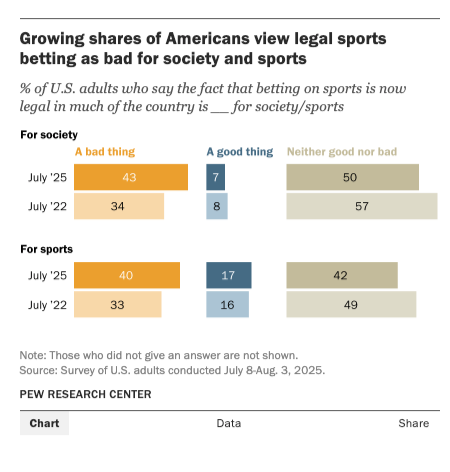
The second and related factor is public opinion. There is some evidence that the public is souring on legalized sports betting. According to Pew, Americans are increasingly inclined to think that legal sports betting is harmful to society and sports. If this trend continues, we should expect more politicians to favor regulation, perhaps even outright bans.
Source: Gramlich, John. “Americans Increasingly See Sports Betting as a Bad Thing for Society and Sports,” Pew Research Center, Oct. 2, 2025. https://www.pewresearch.org/short-reads/2025/10/02/americans-increasingly-see-legal-sports-betting-as-a-bad-thing-for-society-and-sports/
Currently, there is no appetite in Congress for PASPA-style legislation that bans sports gambling nationally. There are, however, several things the federal government might do to regulate the sports gaming environment.
1. Increased regulation or banning of prediction markets. Prediction markets are currently the most contentious sports gambling issue because they involve a tension between federal and state law. After all, what good does it do a state like California to ban sports gambling only to see its citizens bet on games through Kalshi?
There are several ways in which sports prediction markets could face increased regulation, or, far less likely, an outright ban.
First, a federal court might rule that prediction markets in sports are the same as sports gambling, thereby leaving regulation up to each state. Several states have already sued Kalshi, and I expect this issue will eventually end up before the Supreme Court.
Second, the CFTC may decline to certify sports prediction markets. Given that the CFTC is currently populated with Trump loyalists, this is unlikely to happen until after a change in White House.
Third, Congress could pass a bill to regulate sports prediction markets. There are currently four such bills pending in Congress, the most ambitious of the lot is from Senators John Curtis (R-UT) and Adam Schiff (D-CA), “The Prediction Markets Are Gambling Act,” which would prohibit prediction markets from taking contracts on sports and elections. There isn’t much chance any of these bills will pass, and even if they do, they will likely face a Trump veto.
2. Regulation on Prop Betting. Another contentious sports-gaming issue that could prompt federal action is prop betting.
There are currently four bills before the U.S. Congress that would prohibit prop bets on college athletics, three introduced by Democrats and one by a Republican. While prop betting is a growing concern, there isn’t enough of a bipartisan consensus to force Congress to act.
Rather than federal legislation, I expect prop betting will face increasing resistance from states, sports leagues, and sportsbooks. Around 20 states already limit prop betting in some way—usually banning the practice for college sports—and more are moving in that direction. Sports leagues, especially the NCAA, have been active in lobbying to end or regulate prop bets. And sportsbooks, which have a financial incentive to protect the integrity of the game, are starting to self-limit their prop bet offerings.
3. Tax policy. Recently, there has been a significant change in federal tax policy on gambling winnings and losses. Previously, gamblers were allowed to deduct their losses up to the amount of their winnings. However, the “One Big Beautiful Bill” of 2025 limited those deductions to 90 percent of winnings. That means that a gambler who breaks even would still have to pay taxes. A bill is currently before Congress that would restore the full deduction.
4. Safeguards. Several congressional bills include provisions that add guardrails to sports gaming, including restrictions on advertising and increased resources to address problem gambling. Advocates hope that sports gambling advertising will go the way of Joe Camel. Again, federal action is a long shot, but we should expect states will increasingly set their own safeguards.
In summary, the future of sports gambling in America depends on maintaining the integrity of the game. If major scandals erupt, the pressure on the federal government to “do something” will increase. If not, I expect we’ll see more states legalize sports betting and the industry will continue to enjoy exponential growth.
Conclusion
The legalization of sports gambling in America raises many interesting federalism issues. Until 1992, the decision was mostly left to the states, with only Nevada accepting bets. Congress then attempted to prevent more states from legalizing sports betting with its Professional and Amateur Sports Protection Act (PASPA) of 1992. The Murphy v. NCAA (2018) ruling held that Congress overreached its authority by forcing states to do things they did not want to do. After Murphy, the regulation of gambling reverted to the states; this time, however, most states have jumped at the action.
It is helpful to compare the American federal system with a more unitary system, like the United Kingdom’s. In the UK, ultimate legal authority rests with Parliament; there are no constitutionally protected rights for individual regions, as in the United States. Consequently, the UK has a uniform policy: gambling is legal and highly regulated. It doesn’t matter whether you’re in London or Manchester; the betting rules are the same.
There are pros and cons to having a federal system for sports gambling.
One of the benefits of devolution is that it brings democracy closer to the people. If Utahns think gambling is a sin but New Jerseyans love a good parlay, then federalism allows both to get what they want. And if you live in Salt Lake but really like gambling, you can always move to Atlantic City. You don’t get these options in a unitary system where the federal government calls all the shots.
Moreover, federalism provides “mini-laboratories of democracy,” where states can experiment with different models and copy what works elsewhere. For example, if the states that allow mobile gaming enjoy greater revenue, other states might learn from that and adopt the practice.
Finally, there is the Constitutional argument that, under the 10th Amendment, any power not delegated to the federal government is reserved to the states. Since the federal government has been unwilling to take a definitive stand on sports gambling, that decision rightly belongs to the states, as the Supreme Court concluded in Murphy.
There are, however, considerable downsides to devolving sports gambling policy to the states. The most notable is the patchwork of state laws, which makes things confusing for citizens and a headache for companies.
Devolution also makes it hard to address problematic issues related to sports betting. Take prop bets in college sports. Several states are rightly concerned that such bets could threaten the integrity of the game and have banned the practice. However, a few states banning prop bets does little good if other states don’t follow suit. This is a case where a centralized, one-size-fits-all policy makes sense.
The strangest thing about the current sports gambling environment is that it is a confusing mix of centralization and devolution that gives us the worst of both. Prediction markets and, to a lesser extent, DFS are legal for all Americans, while sports gambling is technically up to the states. In effect, the government has said, “Gambling on sports is legal for all Americans,” and “states can choose whether to legalize gambling.” That makes no sense. Either the federal government sets rules for everyone, or each state makes its own decisions. It can’t be both.
On this last point, I’ll bet that prediction markets will end up before the Supreme Court, and the Court will rule that (a) prediction markets are gambling, and (b) they can be regulated by states. That won’t end prediction markets; it will just make them more like sports gambling, in which states get to decide.
By the way, an open Polymarket contract is currently taking bids on whether the Supreme Court will grant certiorari to a case involving sports prediction markets by the end of 2026. As of March 25, a “yes” contract was selling at 66 cents.